There are some pieces of kit you remember. The M1 Garand, with its solid wood stock and that satisfying *ping*. The heavy wool blanket that smells of damp earth and history. But then there are the pieces you don't think about until you desperately need them. The humble, unassuming bits of canvas and webbing that hold everything together. For me, one of those unsung heroes has always been the entrenching tool carrier.
I learned that lesson the hard way at a tactical event years ago. Rain, the kind that soaks you to the bone, had turned the ground into a thick, soupy mud. My buddy, a "new guy" rocking an early-war kit, was wrestling with his M1910 T-handle shovel, a cumbersome beast at the best of times. Me? I just unhooked my carrier, unfolded my M1943 E-tool, and got to work. In the time it took him to get his shovel untangled from his pack, I had the beginnings of a respectable foxhole. That’s when it clicks. That’s when you understand that every single piece of gear tells a story of battlefield evolution.
And the story of the US M1943 Entrenching Tool Carrier (Repro) is a story of pure, unadulterated pragmatism.
More Than Just a Shovel Cover: The Unsung M1943 E-Tool Carrier
From the T-Handle to the Tri-Fold: A GI's Best Friend Evolves
To really appreciate the M1943 carrier, you have to understand what came before it. For the first part of the war, the American GI was issued the M1910 entrenching tool—basically a small spade with a fixed T-shaped handle. It was tough, no doubt, but it was also awkward. It snagged on branches, dug into your back, and required a fairly complex carrier to attach to your haversack.
Then came the M1943 Entrenching Tool. What a game-changer. This ingenious device could fold down twice into a compact, flat package. It could be locked into a 90-degree angle to be used as a pick or hoe, or fully extended as a shovel. It was more versatile, more portable, and frankly, a godsend for the infantryman on the move. But a new tool needed a new home. And so, the M1943 Entrenching Tool Carrier was born.
This wasn't some over-engineered piece of equipment. It was a simple, rugged envelope of canvas designed to do one job: protect the E-tool and keep it securely fastened to the soldier's gear, ready at a moment's notice. No more fumbling. No more snagging. Just pure, battlefield-tested efficiency.
The Devil's in the Details: What Makes the M1943 Carrier Correct?
Now, for us reenactors, this is where the grammar of GI gear gets interesting. It’s not enough to just have a folding shovel cover; you need the *right* one for your impression. The M1943 carrier is a hallmark of the mid-to-late war period, and getting the details spot-on is what separates a good impression from a great one.
The Khaki and OD #7 Conundrum
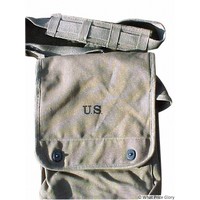
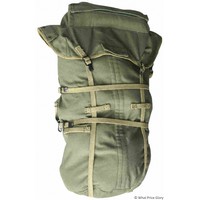
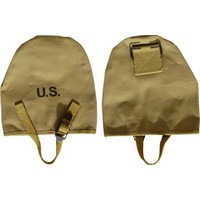
Take a look at a quality reproduction, like this excellent M1943 E-tool Carrier. You'll notice the body is a classic khaki (often designated OD #3), but the trim—the webbing around the edges—is a darker, richer green. That's Olive Drab #7. This two-tone appearance is a signature of transitional and late-war production, as the army shifted its supply chain to the new, darker color. Seeing that OD #7 trim is a dead giveaway that you're looking at a piece of gear intended for the push into Germany, not the landings in North Africa.
Built for the Bulge, Not for Normandy Beaches
This detail places the carrier squarely in the timeline. While the M1943 E-tool started seeing issuance in late 1943, it became truly widespread throughout 1944. This means the M1943 Entrenching Tool Carrier is the absolute standard for any GI impression from D-Day onward. If you're portraying a rifleman in the hedgerows of Normandy, slogging through the Huertgen Forest, or freezing in a foxhole near Bastogne, this is the carrier your kit needs. It’s a quiet testament to the massive logistical effort to re-equip the entire US Army in the midst of the world’s largest conflict.
Life on the Line: How the E-Tool (and its Carrier) Saved Lives
You have to remember, the entrenching tool was far more than a shovel. When you hear veterans talk, you realize it was a multi-tool born of desperation and ingenuity. A GI would sharpen the edge of his E-tool to a razor's keenness, making it a formidable close-quarters weapon. He'd use the flat of the spade as a makeshift frying pan to heat his rations. He'd clear brush, hammer in tent stakes, and even use it as a paddle.
The M1943 carrier kept this vital tool protected from mud and grime that could foul the folding mechanism, ensuring it worked when seconds counted. The simple flap and lift-the-dot fastener meant a soldier, even with numb fingers in the cold of the Ardennes, could get his tool out fast. It wasn't just carrying a shovel; it was carrying potential. The potential to dig in and survive an artillery barrage. The potential to defend oneself when ammunition ran low. The potential to have a single hot meal in a week of cold misery.
Getting Your Impression Right: The Reenactor's Perspective
In our world of living history, this simple canvas pouch is a vital connector. It properly attaches to the back of the M1928 haversack or can be slung from the pistol belt. Its presence instantly dates your kit to that crucial 1944-45 period. Without it, your late-war impression feels... incomplete. It’s like having a Garand without a cartridge belt. You're missing a fundamental piece of the puzzle.
Finding a good reproduction that gets the canvas weight, the color, and the hardware right is key. You want one that feels tough, like it could actually survive a campaign. The feel of that rough canvas, the solid *snap* of the fastener—it all adds to the immersive experience we're chasing.
A Humble Hero of the Hedgerows
So, the next time you're assembling your kit, don't overlook this humble rectangle of stitched canvas. It's more than just a cover. It’s a symbol of industrial might, a piece of brilliant tactical evolution, and the silent partner to one of the GI’s most important tools. It represents the difference between fumbling with outdated gear and having the right tool for the job, right when you need it most. It's a small piece, sure, but it tells a massive story.