More Than a Bag: The Story of the US Army M-1936 Musette Bag
There are some pieces of kit that just feel right. You know the ones I’m talking about. They’re not just replicas; they’re keys to a different time. The moment you touch them, the seventy-odd years melt away. For me, that item has always been the US Army M-1936 Musette Bag. The rough, reassuring texture of the khaki canvas under your fingertips, the earthy smell, the solid *clink* of the metal fittings… it’s the sound of history.
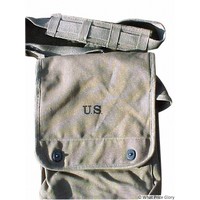
I remember my first big Battle of the Bulge reenactment. Bitter cold, snow crunching under my boots, and my breath pluming in the frigid air. That M-1936 musette bag was strapped firmly to my back, a comforting weight. It felt… authentic. Like I wasn't just carrying extra socks and some hardtack, but the weight of the stories that came with it. This wasn't just a bag; it was a canvas box of possibilities, the unsung workhorse of the American GI.
From West Point to the Ardennes: The Musette Bag's Journey
Before the M-1936 came along, the standard-issue pack was the M-1928 Haversack. Ask anyone who's had to pack and unpack one of those labyrinthine things, and they'll tell you it was a nightmare. A confusing mess of flaps and straps that was anything but user-friendly in the heat of the moment. The Army knew it needed something better, something more adaptable for a new, faster kind of war.
Not Your Average Haversack: A Design for a New Kind of War
Enter the M-1936 Field Bag, or as we all lovingly call it, the Musette Bag. What made it so revolutionary? Simplicity and versatility. It was essentially a single, large compartment with a divider, small pockets on the side and back, and a simple flap closure. No more origami-folding your shelter half just to get your pack closed. But the real genius was in how you could carry it.
Using the two "D" rings on the back, you could clip it directly onto the M-1936 Suspenders, wearing it high on your back like a conventional pack. Or, attach the general-purpose strap (sold separately, of course—some things never change!) and sling it over your shoulder like a modern messenger bag. This adaptability was its superpower.
The Officer's Companion
Initially, the WWII Musette Bag was intended for officers. It was perfect for carrying maps, binoculars, paperwork, and personal items without the bulk of the full field pack. You’ll see it slung over the shoulders of countless lieutenants and captains in period photos, from dusty command tents in North Africa to staff meetings behind the lines in France. It was a symbol of command—practical, understated, and ready for action.
The Paratrooper's Lifeline
But the bag's destiny was bigger than the officer corps. When the elite airborne divisions were formed, they needed gear that was compact, accessible, and rugged. The M-1936 Musette Bag fit the bill perfectly. Paratroopers would often wear it, heavily loaded, on their chest during a jump. This kept essential equipment—demolitions, extra ammo, medical supplies—within immediate reach the second their boots hit the ground. For a trooper landing scattered and alone behind enemy lines on D-Day, the contents of that musette bag could mean the difference between life and death. It wasn't just designed; it was engineered for chaos.
Getting the Details Right: Why This Reproduction Stands Out
As a reenactor, authenticity is everything. It's the difference between looking the part and *feeling* the part. And let me tell you, this US Army M-1936 Musette Bag Reproduction gets it right. The durable canvas construction has the correct weight and weave. The stitching is solid, the color is spot-on, and the hardware feels just like the originals I’ve handled. It’s a piece of gear built to be used, not just displayed. It's ready to be stuffed with your gear, slung over your shoulder, and carried through a muddy, rain-soaked tactical event. It's stitched with the ghosts of Normandy, and it's ready for you to add your own story.
Packing for Battle (or the Weekend): Using the Musette Bag Today
So, what do I pack in mine? For an event, the main compartment holds my mess kit, extra rations, and a wool sweater. The divider keeps things from rattling around too much. The side pockets are perfect for a first-aid pouch and cleaning kit, while the back pocket is great for a map and notepad. It’s amazing how much you can intelligently load into this seemingly simple WWII officer gear. It forces you to be efficient, to think about what’s truly essential—a lesson every soldier from Caesar's legions to today has had to learn.
The Legacy of a Simple Canvas Pack
The M-1936 Musette Bag is more than a historical artifact. It's a testament to brilliant, practical design. It served every echelon of the US Army in WWII, from a general carrying strategic plans to a paratrooper carrying a prayer book and a block of TNT. It was a piece of equipment that adapted to the soldier, not the other way around.
Holding this high-quality reproduction in your hands, you connect with that legacy. You understand the thought that went into its creation and the incredible history it witnessed. It’s an essential piece for any US WWII reenactor, historian, or collector. Trust me, once you clip it to your suspenders, you won't know how you ever did without it.


No comments:
Post a Comment