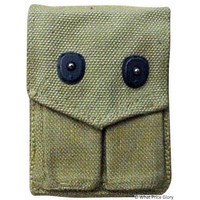
More Than Just a Shovel Cover: The Unsung Hero of the Soldier's Kit – The M1910 Shovel Carrier

Close your eyes for a moment. Picture the mud of the Meuse-Argonne. It’s a thick, greedy mud that pulls at your boots and cakes your puttees. The air smells of wet earth, cordite, and fear. Somewhere above, the world is tearing itself apart, but down here, in the relative quiet of a freshly dug shell scrape, your world has shrunk to the few feet of earth around you. And the tool that got you here, the tool that might just keep you alive through the night, is your M1910 entrenching tool. But where do you keep such a vital piece of gear? You keep it in its carrier. The simple, unassuming, and absolutely essential US M1910 Shovel Carrier.
It’s one of those bits of kit that gets overlooked. We all love the rifles, the helmets, the iconic field jackets. But history, real history, is often found in the mundane. The unglamorous workhorses of a soldier’s loadout tell the truest stories. And let me tell you, the M1910 shovel and its carrier have stories to tell.
From the Punitive Expedition to the Hedgerows: The M1910's Long Service
When the U.S. Army adopted the M1910 infantry equipment, it was a revolution. They moved away from the old, brittle leather that cracked in the heat and rotted in the damp, and embraced rugged, adaptable canvas duck. At the heart of this new system was a simple piece of gear designed to hold the T-handle entrenching tool: the M1910 Shovel Carrier.
Think about its service life. First issued in 1910, this humble carrier went south with Pershing's men chasing Pancho Villa. It crossed the Atlantic to the trenches of France, and an entire generation later, it landed on the beaches of North Africa, Sicily, and even Normandy. It wasn't officially replaced until the M1943 folding shovel and its carrier became widely available in 1944. That's over 30 years of service. Thirty years of digging, scraping, and fighting. Incredible.
The Great War: A Doughboy's Best Friend
In World War I, the shovel was life. It wasn't just for digging trenches; it was for scooping out a shallow scrape under fire, improving a position, or burying a comrade. The rhythmic scrape and grunt of trenching was the soundtrack of the Western Front. A soldier’s shovel was his key to survival, and the T-handle shovel cover kept it secure and ready. Slid onto the back of the haversack or hooked directly to the pistol belt, it placed the tool within easy reach. The heavy canvas protected the soldier's back from the cold steel of the shovelhead and kept the tool from snagging on barbed wire. And let’s be honest, when the fighting got close and personal in the labyrinth of a German trench, a sharpened shovel was a fearsome weapon. The carrier that held it was the scabbard for that last-ditch blade.
A Relic in a New War? The M1910 in WWII
By the time American GIs waded ashore in 1942, the M1910 carrier was already an old-timer. Newer gear was coming into the system, but the vast, rapid expansion of the Army meant that old reliable equipment was pressed into service. You’ll see photos of GIs in North Africa and Italy, even D-Day, still carrying the old T-handle shovel in its M1910 carrier. It soldiered on, a silent testament to a generation of diggers, serving right alongside the new M1928 equipment. It’s a perfect example of how armies actually function: using what works until something better is available in sufficient numbers.
Deconstructing the Doughboy’s Digging Kit: The Carrier Itself
So, what makes this carrier special? It’s all in the brutally simple, effective design. This isn't some fancy piece of technology. It’s a pocket, a hook, and a promise of durability.
Built for the Grind
The original carriers were made from a heavy-duty cotton canvas duck, usually in a khaki or olive drab color. It feels coarse and stiff in your hands, designed to resist thorns, snags, and the constant abrasion of a soldier's life. I remember my first WWI reenactment, a cold, wet weekend in Pennsylvania. My cheap, knock-off carrier—not this one, mind you—ripped on the first morning crawling through the underbrush. It taught me a valuable lesson about authenticity and quality... a lesson the Doughboys learned the hard way. A good reproduction, like the economical reproduction of the M1910 carrier we're talking about, understands that the material matters.
The Heart of the System: The M1910 Belt Hook
The real genius of the M1910 system is the double hook hanger on the back. This bent piece of heavy gauge wire is what integrated the entire system. You’d slide the hook into the brass grommets on the pistol belt or the haversack, and it would lock in with a satisfying, solid *thunk*. It’s a sound every reenactor knows. That hook held the weight of the shovel, about 2 pounds of steel and wood, securely through marches, charges, and belly-crawls. It didn't flap around. It didn't come loose. It just worked.
Getting it Right: Why This Reproduction Hits the Mark
For a reenactor, whether you’re portraying a Doughboy going over the top in 1918 or an early-war GI hitting the beach in Operation Torch, this carrier is a must-have. Its incredible service history makes it one of the most versatile pieces of web gear you can own. When you're putting together your impression, you want gear that looks the part and, more importantly, *feels* the part.
Having the correct carrier holding your T-handle shovel on your back completes the silhouette. It's that final touch of authenticity. When you feel that slight weight on your hip, you're not just carrying a prop. You're carrying a small piece of the burden that millions of young men carried before you. It’s a tangible connection to the past, a canvas pocket that holds more than just a shovel—it holds a legacy of grit, resilience, and survival.