The Unsung Heroes of the March: Why Your WWII Boot Heels Matter
There's a certain sound that defines a World War II reenactment. It’s not just the crack of a Garand or the rumble of a half-track. It’s something more fundamental, more personal. It’s the percussive heartbeat of an army on the move: the rhythmic, solid sound of dozens of boots hitting the ground in unison. It’s a sound that connects us directly to the GIs we strive to portray. But what happens when that sound goes soft? What happens when that solid *thump* becomes a pathetic, worn-out scuff? Your impression, my friend, starts to fall apart from the ground up.

More Than Just a Shoe: The Story of US Garrison and Jump Boots
Every single piece of our kit tells a story, but none more so than our footwear. It’s the literal foundation of our connection to the past. In the US Army of the 1940s, two types of footwear stood out, each with its own distinct tale: the humble garrison shoe and the vaunted jump boot.
The Dependable Garrison Shoe: Backbone of the Army
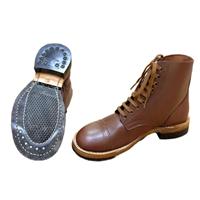
Let's be honest, the standard-issue service shoe, often called the "garrison shoe," wasn't the most glamorous piece of equipment. It was the workhorse. Millions of these were made, worn by everyone from fresh-faced recruits in basic training stateside to quartermaster clerks behind the lines in Normandy. Typically a russet-brown leather oxford, its composition sole and solid rubber heel were designed for durability on pavement and hard-packed ground. They weren't flashy, but they were the footwear that moved the largest army in American history. To wear them is to represent the vast, essential majority of the soldiers who served.
The Legendary Jump Boot: A Paratrooper's Pride
And then there were the jump boots. Ah, the Corcoran jump boots. Just saying the name gives you a little thrill, doesn't it? Taller, sleeker, with a distinctive capped toe and a rakish angle to the heel, these weren't just boots; they were a statement. They were a badge of honor for the elite paratroopers of the 82nd and 101st Airborne Divisions. Troopers would go to great lengths to keep them polished to a mirror shine, often blousing their trousers meticulously over the top to ensure everyone knew who they were. The slanted heel was designed to help absorb the shock of a parachute landing—and, let's face it, it just looked incredible. Owning a pair, even a reproduction, feels like holding a piece of pure martial swagger.
The Grind of History: Why Details Like Heels Are Crucial
Whether you're portraying a Pfc. in a line infantry company or a Screaming Eagle waiting for the green light over Normandy, the integrity of your boots is paramount. And the first point of failure, the piece that takes the most relentless beating, is always the heel.
From the Cobblestones of Carentan to the Modern Reenactment Field
I remember one particularly wet event a few years back. We were doing a tactical in a recreated French village. The cobblestones were slick with rain. I watched a buddy, a good reenactor with an otherwise immaculate impression, take a hard fall. Why? His jump boot heels were worn down to a smooth, dangerous curve. All the authenticity of his M1 helmet and meticulously packed musette bag was undone by a worn-out piece of rubber. It was a stark reminder: the GIs wore their gear hard, and maintenance was a constant battle. A worn-down heel isn't just inaccurate; it’s a safety hazard. It’s one of those silent saboteurs of an otherwise perfect impression.
The Sound of Authenticity
Think about the sound again. The original heels on these boots were made of a hard, dense rubber. They made a sharp, authoritative *clack* on pavement. Modern running shoes, or boots with soft, worn-out heels, just don't produce that sound. They *thud*. They *squish*. Getting the sound right is a subtle but powerful layer of immersion, for you and for the public. It's the difference between looking the part and truly *feeling* it. That's why having the right kind of replacement heels isn't just about repair; it's about restoration. It's about bringing that authentic sound, that percussive heartbeat, back to your impression.
Keeping the Legacy Alive: Repairing Your Boots the Right Way
Your boots are an investment. A good pair of reproduction garrison shoes or jump boots costs a significant amount of money. Tossing them out because the heel is gone is a waste, and frankly, it's not what a GI would have done. They would have found their unit's cobbler and gotten them fixed.
A Stitch in Time: The Importance of Maintenance
We owe it to the memory of these soldiers to care for our gear with the same diligence. Cleaning your leather, checking your stitching, and yes, replacing your heels before they become a problem, is all part of the hobby. It's the quiet, behind-the-scenes work that makes the public-facing impression so powerful. Taking the time to properly repair your footwear with accurate parts connects you to that historical reality of making do and keeping your equipment in fighting shape.
Finding the Perfect Fit: Our Replacement Heels
This is where a proper set of Replacement Heels for US Garrison Shoes & Jump Boots becomes absolutely essential. You can't just slap any old heel from a modern shoe repair shop on there and call it a day. The shape, the material density, the look—it all has to be right. These replacement heels are designed to match the specifications of the originals, ensuring your repair is not only functional but historically accurate. They give you back the solid footing, the correct profile, and the authentic sound you need. They are more than just rubber and nails; they're the final punctuation on a sentence of authenticity.
So next time you're cleaning your kit, flip over your boots. Take a hard look at those heels. Are they telling the right story? Are they ready for the long march? If not, you know what to do. Honor the history, perfect your impression, and walk with confidence. Walk like a GI.