The Soul of a Soldier: Why Original WWII Half-Soles Are a Reenactor's Holy Grail
There's a ritual every one of us goes through before a big event. The familiar weight of the M1 helmet, the rough texture of the wool trousers, the metallic click of a Garand clip sliding home. But it all starts from the ground up. It starts with the boots. You pull them on, yank the laces tight, and for a moment, you feel that connection to the past. An army, they say, marches on its stomach. A nice sentiment, but it’s a lie. An army marches on its feet, and the men of the Second World War marched clean across Europe on leather, hobnails, and good, solid American rubber.

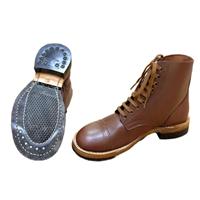
I’m talking, of course, about the very foundation of the GI’s mobility: his boot soles. And today, I’m holding something special. Something that sends a little shiver of historical reverence down my spine. It’s not a helmet, not a rifle. It’s a set of Original WWII US Replacement Half-Soles. And believe me, this is where a good impression becomes a great one.
More Than Just Tread: What's in My Hand?
You look at one of these, and at first, you just see a piece of dark, hard rubber. But you’re not just looking at a shoe part. You’re looking at a piece of the 1940s American war machine. This is a time capsule you can hold in your palm.
Ghosts of the Production Line
These aren't reproductions. Let that sink in. These are genuine, unissued, WWII-production half-soles. They rolled off a factory line in Akron or Dayton, inspected and packed away in a crate, destined for a Quartermaster depot and then a forward cobbler's tent somewhere in England, France, or maybe even the Pacific. They were made for a soldier who, by some twist of fate, never wore out his original pair. For eighty years, they’ve just been waiting. When you pick one up, you can almost catch the faint, dusty smell of history—of old rubber and cardboard, a ghost of the factory it came from.
The Miracle of 80-Year-Old Pliability
Now, here's the kicker. Most rubber from that era is now as brittle as a dry leaf. It cracks, it crumbles, it's useless for anything but a static display. But not these. These incredible surplus half-soles are still pliable. You can flex them in your hand and feel the life still in the material. This is a testament to the quality of wartime manufacturing. They built things to last because they had to. This isn't just a collector's item; it's a functional piece of history, ready to finally do the job it was made for.
From the Quartermaster to the Front Line
Footwear was an obsession for the US Army command, and for good reason. They remembered the nightmare of trench foot in the Great War. A soldier with ruined feet is a soldier out of the fight. The development of rugged, reliable footwear was a top priority, and that included the means to repair them in the field.
Keeping the Garrison Grounded and the Paratrooper Ready
These specific half-soles were the go-to replacements for two iconic pieces of GI footwear. First, the standard Type II/Type III Service Shoe, often called the "Garrison Shoe." These were the everyday boots for the vast majority of troops. Second, and perhaps more excitingly for many of us, the Corcoran "Jump Boots" worn by the elite paratroopers of the 82nd and 101st Airborne. The angled heel of a paratrooper boot was designed for hard landings, and the sole beneath it needed to be just as tough to handle marches from Sainte-Mère-Église to Carentan.
A Personal War Story: Why Your Soles Matter in the Mud
Let me tell you a story. A few years back, I was at a particularly wet "Battle of the Bulge" tactical. It rained for 48 hours straight. I was fine, but a newer guy in the squad had a pair of cheap reproduction jump boots he’d bought online. By Saturday afternoon, the glue on his soles gave up the ghost. The entire tread peeled away from one of his boots. He spent the rest of the event sliding around in the slick mud, wrapping his boot in duct tape—hardly the picture of a Screaming Eagle. He learned a hard lesson that weekend: don't let your impression die at your ankles.
The Last 1% of Authenticity
That's what these original half-soles represent. It’s that last one percent. It’s the detail that no one might see, but *you* know is there. It's the difference between wearing a costume and carrying a piece of history. When you have your worn-out boots resoled with a set of these, you are completing a circuit that’s been open since 1944. You're giving this artifact its purpose.
Bringing History Back to Life
Whether you're meticulously restoring a pair of original paratrooper boots you found at a flea market or upgrading a high-quality reproduction to be as accurate as possible, these original WWII boot soles are the only real choice. It's about honoring the material culture of the American GI. It's about respecting the incredible industrial effort that equipped him. It's about feeling that solid, authentic connection to the ground that he once walked. It’s… well, it’s just *right*.
These aren't just pieces of rubber. They are the final, unwritten chapter of a GI's kit, waiting for someone with enough passion for history to finally put them to use. They are the soul of the soldier's journey, ready to march again.