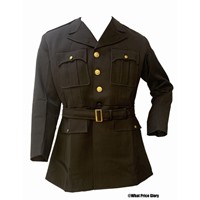
More Than a Shirt: The Story of the US Officer's M37 Mustard Wool Field Shirt
There are some objects that just hum with history. You can feel it when you pick them up. It's a weight, a texture, a story that seeps from the very fibers. For me, few items from the Second World War resonate quite like the US Officer's M37 Mustard Wool Field Shirt. It’s more than a piece of a uniform; it was a second skin for a generation of leaders who guided the US Army from the quiet uncertainty of the interwar years into the crucible of global conflict.
I remember the first time I buttoned up a quality M37 reproduction. I was at a living history event in a stand-in for the Ardennes in rural Pennsylvania. The air had that sharp, winter bite, and as I settled the wool over my shoulders, something shifted. The slight, familiar scratch of the fabric wasn't an annoyance; it was an anchor. It wasn't a costume anymore. In that moment, I felt a flicker of connection to the thousands of young lieutenants and captains who wore this very garment, their minds racing with maps, orders, and the well-being of their men. It’s a sartorial ghost from the eve of the storm.

A Stitch in Time: What is the M37 Wool Shirt?
Adopted in 1937, this shirt was a key component of the US Army officer’s service and field uniform in the lead-up to and early years of World War II. It was designed to be functional, durable, and, importantly, to look sharp. It projected an image of professionalism that was central to the spit-and-polish army of the era.
The "Mustard" Myth and Material Reality
Let's talk about that color. Officially designated as "Olive Drab Shade No. 33," soldiers almost universally gave it the more descriptive—and accurate—nickname: "mustard." But don't picture the bright yellow of French's. This was a complex, earthy, brownish-yellow that could look wildly different depending on the lighting, the dye lot, and how much time it had spent under the sun. This variation is actually a hallmark of authenticity.
And the material? Wool. Good, honest, 100% wool. This wasn't just for looks. Wool is a miracle fabric. It insulates even when damp, it's remarkably durable, and it wicks moisture away from the skin. For a soldier in the field, from the damp chill of a European morning to the cold nights of the North African desert, this shirt was a critical piece of gear. It was their primary torso layer, worn under the M1941 field jacket or the heavier mackinaw coat. You can almost smell that earthy, lanolin scent that authentic wool carries.
The Officer's Edge: Why Epaulets Mattered
What truly sets this shirt apart from its enlisted counterpart are the epaulets. These buttoned shoulder straps were more than just decoration. They were functional platforms for displaying an officer’s rank insignia. A quick glance at a man’s shoulders could tell you if he was a Lieutenant, a Captain, or higher. In the chaos of the battlefield, this silent language of command was vital. The epaulets on the M37 Officer's Shirt sit squarely on the shoulders, subtly changing your posture, making you stand a little taller. This wasn't just clothing; it was armor of a different sort—armor of identity and responsibility.
From Barracks to Battlefield: The M37 in Action
When you look at photos from the Louisiana Maneuvers or the early days after Pearl Harbor, you see the M37 shirt everywhere. It's on the backs of officers pouring over maps in North Africa, directing traffic on the beaches of Sicily, and briefing their men before the jump into Normandy.
A Pre-War Staple, A Wartime Workhorse
The M37 shirt represents a fascinating transitional period for the US Army. It has one foot in the traditional, almost constabulary, army of the 1930s and the other stepping into the massive, mechanized force that would win the war. It was worn with a tie in garrison for a formal appearance but could be opened at the collar in the field. This versatility made it an indispensable workhorse during the first half of the war.
The Evolution of an Icon
Of course, war drives innovation. As WWII progressed, the army recognized the need for a more practical, layered uniform system. The iconic M37 was gradually phased out in combat zones in favor of the more utilitarian Herringbone Twill (HBT) utility shirts and, eventually, the standardized M1943 Field Uniform. However, the mustard wool shirt never truly disappeared. It remained a staple for service and dress wear right up to the war's end, a lingering symbol of the "Old Army" that had risen to the world's greatest challenge.
Feeling History: The Reenactor's Perspective
For a living historian portraying an early-war US Army officer, getting the shirt right is non-negotiable. It’s the foundation of your entire impression. An enlisted shirt won't do. A post-war shirt is anachronistic. The specific cut, the mustard color, and, most importantly, the epaulets of the US Officer's M37 Mustard Wool Field Shirt with Epaulets are what sell the image.
Getting the Details Right
A quality reproduction captures these nuances. The weight of the wool, the placement of the two breast pockets, the gas flap behind the button placket—these details matter. They are the difference between a costume and a uniform. When you pin your rank insignia—those dull glints of brass—onto the epaulets of an accurate M37, you are completing a circuit that connects you directly to the past.
It's a garment steeped in history, woven with the threads of duty and determination. It saw the last days of peace and the first brutal days of war. It represents a generation of American leadership that learned on the job, under fire, and ultimately led the Allies to victory. Owning and wearing one isn't about playing soldier; it's about honoring that memory in the most tangible way possible.


_Trousers_(Light_shade)_M.jpg)