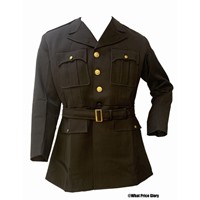
More Than a Shirt: The Story of the Iconic WWII "Chocolate" Officer's Uniform
I remember the first time I saw one up close. It wasn't in a museum, sealed behind glass. It was at a reenactment event in Pennsylvania, draped over a field chair as the morning sun steamed the dew off the grass. The color was what struck me—a deep, rich olive drab that the old-timers had nicknamed "chocolate." It looked solid. Dependable. It looked like history you could actually touch.
This wasn't just any old piece of surplus. This was the US Army Officer "Chocolate" Shirt, the sartorial signature of the Greatest Generation's leadership. And let me tell you, getting the details right on a piece like this... well, it’s everything.

The Birth of a Legend: Why "Pinks and Greens"?
You can't talk about the "Chocolate" shirt without talking about the full ensemble it belonged to: the Class A Officer's Service Uniform, more famously known as "Pinks and Greens." It’s a name that sounds a little odd today, doesn’t it? But it made perfect sense. The "Greens" referred to the olive drab service coat, while the "Pinks" were the light-taupe, almost pinkish-tan trousers. Smack in the middle of this iconic pairing was the dark olive drab wool shirt—our "Chocolate."
A Uniform for a New Kind of Officer
This wasn't your standard-issue grunt's uniform. The Pinks and Greens uniform was a private-purchase item, meaning officers bought it with their own money. This little fact had a huge impact. It allowed for higher quality materials and a much sharper, tailored fit than the standard-issue service dress. It was a status symbol, an immediate visual cue that you were looking at a career man, a leader.
Think about the psychology of that. In a world at war, this uniform projected an image of quiet confidence and professionalism. It was less about battlefield utility and more about garrison smartness. It was the uniform worn by men like Eisenhower, Bradley, and Patton as they planned the liberation of a continent. It whispers tales of drafty command tents and late-night strategy sessions over maps lit by a single bulb.
From the Garrison to the Silver Screen
After the war, Hollywood immortalized the look. Gregory Peck, William Holden, Burt Lancaster—any actor playing a sharp, thoughtful officer in a post-war film was inevitably clad in Pinks and Greens. The uniform became shorthand for American victory and competence. It was, and remains, one of the most handsome military uniforms ever designed.
Getting the Details Right: What Makes an Authentic "Chocolate" Shirt?
For us in the reenactment community, authenticity is the whole game. You can spot a cheap knock-off from fifty yards away. It’s in the color, the cut, and most importantly, the material. That’s why a proper reproduction, like this US Army Officer "Chocolate" Shirt, is so critical.
The Feel of Wool Gaberdine
The original shirts were made from wool gaberdine, and there’s simply no substitute. The moment you touch it, you know. It has a smooth, tight weave that drapes beautifully, resisting wrinkles far better than simple wool flannel. It’s got a bit of heft to it. When you pull it on, you feel the quality. It’s that slight, reassuring scratchiness of real wool that tells you you’re wearing something substantial. This isn't a costume; it's a piece of clothing built to last.
The Perfect Shade of Olive Drab
And the color! Oh, the color. Getting that "chocolate" brown, or more accurately, Olive Drab Shade No. 54, is paramount. It’s a dark, earthy tone that can look different depending on the light. Too brown and it looks like a modern hunting shirt. Too green and it misses the mark entirely. A quality reproduction nails this specific, historic shade, ensuring your impression is spot-on from top to bottom.
Living History: The "Chocolate" Shirt in Reenactment
I remember one of my first events as a freshly-minted "Second Lieutenant." I had spent weeks getting my kit together, but the piece I was proudest of was my officer’s uniform. Buttoning up that wool gaberdine shirt, I felt… different. My posture straightened. The way I walked changed. It’s hard to explain, but when you wear a uniform this historically significant, you’re not just playing a part. You’re shouldering a small piece of its legacy.
More Than a Costume, It's a Connection
That's what this is all about. It’s about connecting with the past in a tangible way. When you're out in the field, smelling the woodsmoke and cleaning your M1 Garand, the authenticity of your gear makes the experience real. This shirt isn’t just an article of clothing; it's a time machine made of wool. It connects you to the men who wore it for real, making decisions that shaped the world we live in today.
A Word on Care and Keeping
A quick, practical note. A shirt made of 100% wool gaberdine is an investment. You don’t just toss this in the washing machine. It’s dry clean only, and for good reason. You want to preserve the fabric's integrity, color, and shape for years of events. Treat it with the respect it deserves, and it will serve you well, just as it served the officers of the US Army.
The Enduring Legacy of the "Chocolate" and "Pinks"
The "Chocolate" shirt and the Pinks and Greens uniform were officially replaced in the 1950s, but they never truly disappeared. They live on in photographs, in films, and in the dedicated work of historians and reenactors. They represent a unique moment in time when style and serviceability met, creating an unforgettable symbol of the American officer.
Owning a well-made reproduction is about more than just looking the part. It's about honoring that legacy. It's about feeling the weight of the wool and, for a brief moment, connecting with the spirit of the generation that wore it first.

_Trousers_(Light_shade)_M.jpg)