I remember the first time I got my WAC officer impression dialed in. I’d spent months hunting down the right insignia, tailoring the jacket, polishing the shoes until I could see my own tired, happy face in them. But something was missing. It wasn't until I held this specific cap in my hands, felt its substantial wool, and placed it on my head—tilted just so—that the whole thing clicked into place. In the reflection of a dusty jeep window, I saw more than just a costume. I saw a story.
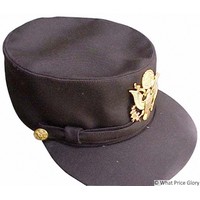
That story belongs to the incredible women of the Women's Army Corps. And this cap, the US WAC Officer's Overseas Cap (Reproduction) | OD Elastique, is a crucial piece of it.
More Than a Hat: The Story and Soul of the WAC Officer's Overseas Cap
A New Kind of Soldier, A New Kind of Uniform
Before we dive into the beautiful details of this cap, let's set the stage. It's World War II. The US Army realizes it has a massive manpower shortage. The solution? Groundbreaking. Revolutionary. It was the creation of the Women's Army Auxiliary Corps (WAAC) in 1942, which became the full-fledged Women's Army Corps (WAC) a year later. Suddenly, over 150,000 American women were serving *in* the Army, not just with it. They were mechanics, clerks, cryptographers, and air traffic controllers. They were soldiers.
And every soldier needs a uniform. The WAC uniform was designed to be smart, professional, and functional. It had to command respect. For the officers leading these new companies of women, every detail mattered, right down to their headwear. This brings us to the iconic overseas cap, affectionately nicknamed the "Hobby Hat" after the first WAC Director, Colonel Oveta Culp Hobby.
Deconstructing a Symbol: What Makes This Cap Correct?
As a reenactor, authenticity is my creed. A photograph might not show the feel of a fabric, but when you’re standing in formation, you know. You just *know* when something is right. This reproduction cap gets it right, and here's why.
The Fabric of Command: OD Wool Elastique
First, touch it. That distinctive, diagonal ribbed texture? That’s wool elastique. This wasn’t the standard serge wool of an enlisted soldier's garrison cap. Oh no. This was a higher-grade material reserved for officers' uniforms. It’s a tightly woven worsted wool that has a bit of natural stretch—or "give"—hence the name "elastique." It holds a crease like a dream and was far more durable. Running your thumb over the fabric of this WAC officer's cap, you feel that quality. It’s a subtle detail, sure, but in our world—the world of getting history *right*—subtle details are everything.
The Mark of Leadership: Officer's Piping
Now, look at the edge. That elegant braid of gold and black is not just decoration. It's a statement. This is the official "bicolor" piping for officers of the US Army during the era. Enlisted WAC personnel wore a different "old gold" and "moss green" piping. This simple line of thread immediately identified the wearer as a woman in a position of authority—a lieutenant, a captain, a major. It was a visual cue of her responsibility, her training, and her commission. A folded piece of resolve, stitched right onto the cap.
Form, Function, and a Touch of "Flair"
The overseas cap, or garrison cap, was the standard field and duty headwear. It was practical. It could be folded flat and tucked into a belt or pocket when entering a building. But let me tell you, there was an art to wearing it. Army regulations AR 600-40 were explicit: it was to be worn on the right side of the head, with the front edge one inch above the eyebrows, and the vertical crease centered on the nose. When creased and worn correctly, it gave a sharp, confident, and professional look that was undeniably military.
On Her Head, In the Field: Wearing the Cap During Wartime
Imagine a WAC Captain in London in 1944. The air is thick with the tension of the coming invasion. She’s rushing from a planning meeting at Eisenhower's headquarters to her billet, her overseas cap perched correctly on her head. The wool protects her from the persistent English drizzle. The gold braid glints under the dim blackout lights. That cap isn't just part of her uniform; it's part of her identity. It’s seen long nights pouring over decrypted messages, rainy days supervising motor pools, and maybe even a few brief, cherished moments of laughter in a London pub. It was a constant companion, a symbol of her service that she carried with her from basic training to V-E Day.
Getting the Impression Right: A Reenactor's Perspective
For those of us who strive to honor these women through living history, getting the WAC officer impression correct is paramount. You can have the perfect Pallas Green officer's blouse and skirt, but if you top it with an enlisted cap or one made of the wrong material, the whole image falls apart. This reproduction is a game-changer. The use of dark OD wool elastique and the correctly colored officer's braid means you can build your entire impression around a solid, authentic foundation. It’s the piece that pulls everything together, transforming a collection of clothing into a credible, respectful portrayal of a WWII hero.
A Legacy Folded in Wool
This cap is more than just a reproduction. It's a key to a story. It's a tangible link to the pioneering women who answered their nation's call, who broke down barriers, and who proved that courage and leadership know no gender. Holding it, wearing it, you're not just playing a part. You're carrying a legacy. It's a simple slash of olive drab that carried the weight of a commission and the hope of a nation.


No comments:
Post a Comment